Does AI Extrapolate? Or how a perfectly innocent machine learning question somehow ends with Gödel, God, and the informational substrate of reality

The eternal debate: does artificial intelligence extrapolate? If so, the next GPT 8.6 Universe could potentially solve every problem facing humanity; if not, we are pouring GDP-level money into a truly stochastic parrot.
The basics
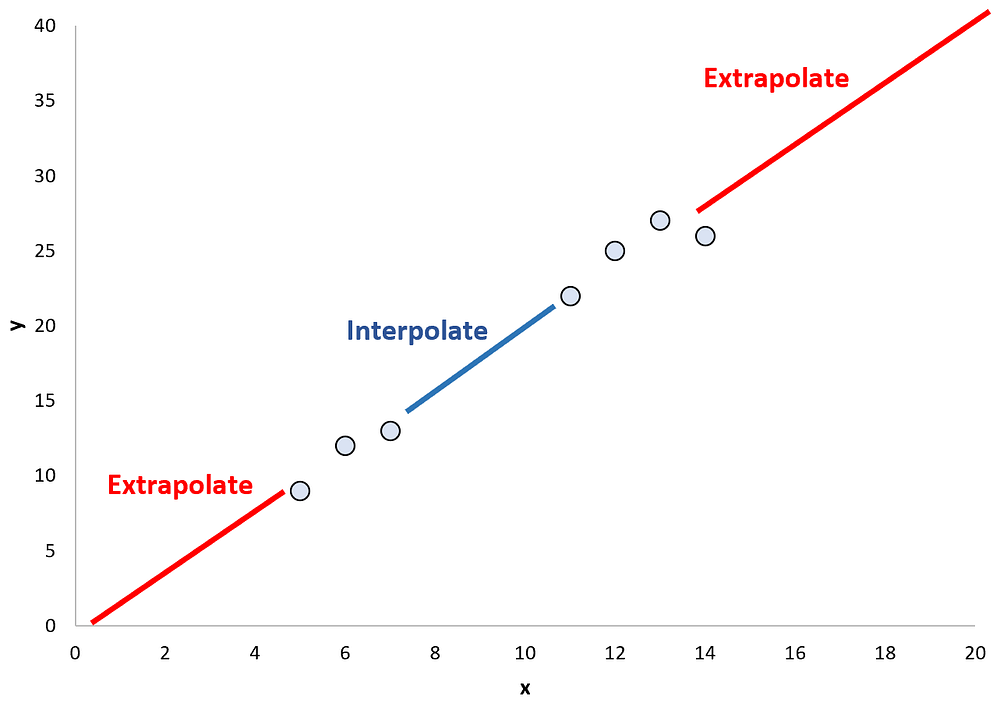
Let’s start with the textbook definition of extrapolation: “Interpolation predicts between observed points; extrapolation predicts beyond them.”
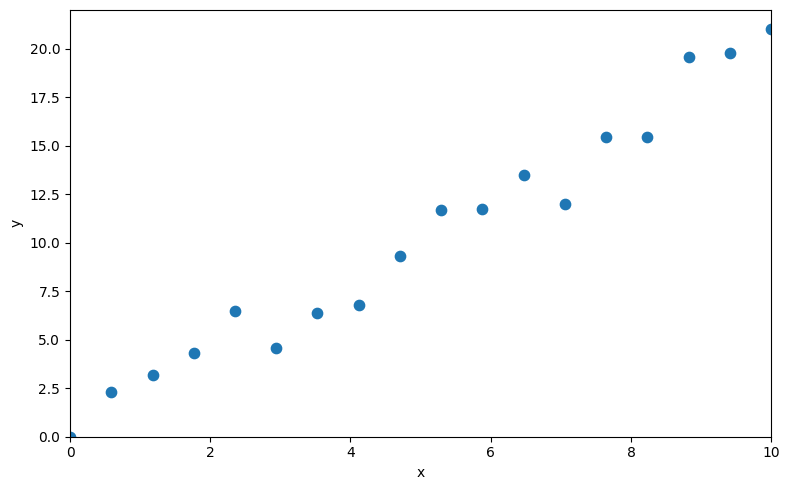
If we take this classic (boring) definition, then obviously AI can extrapolate. Consider this set of points in the range [0, 10]:
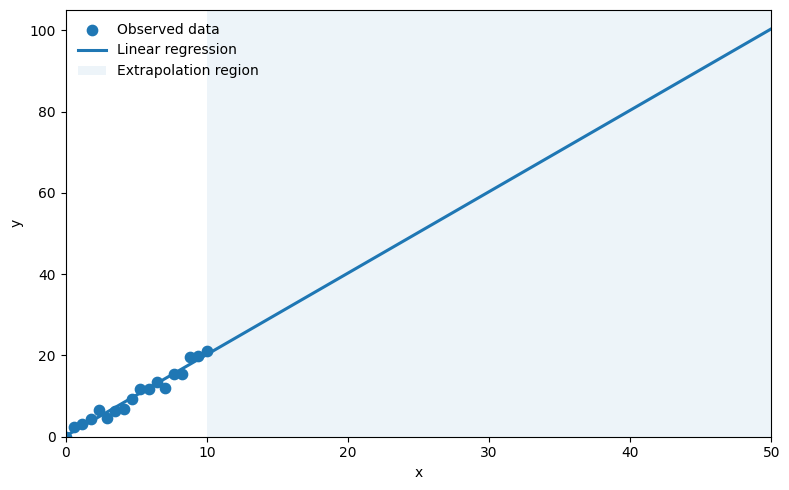
A simple linear regression model, “y = 2*x”, lets us interpolate between observed points and extrapolate beyond the dataset, for arbitrarily large values of x:
Hell yeah, under our basic definition, AI can extrapolate. Whether it does so well is another question. End of the debate, right? Or… is this simple mathematical concept really what you have in mind when you ask, “Can AI go beyond data?”
Large language models (LLMs) actively take part in human research and development, with daily news of GPT “solving” the Navier-Stokes problem or Claude discovering novel enzyme systems. This HAS to be extrapolation in the cool sense, right? If discovery is not extrapolation, then what is?
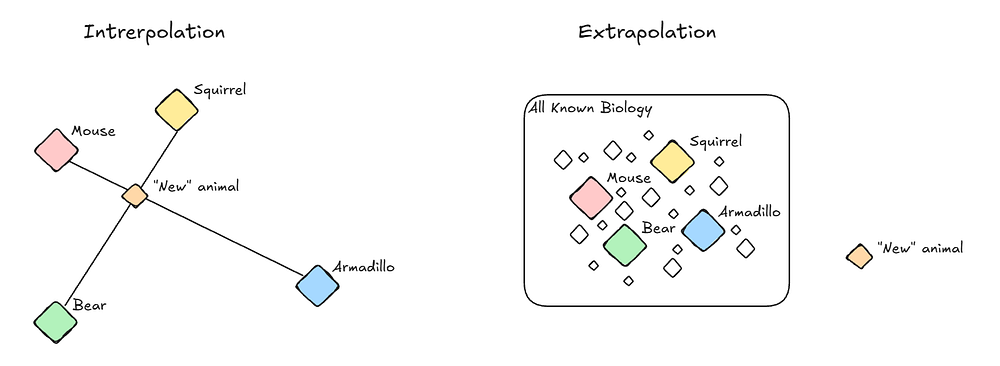
Let’s introduce a stricter definition. When we ask whether AI can extrapolate, we usually mean something closer to producing useful knowledge where the training data provides no obvious answer. However, with generative models like LLMs or image diffusion models, the concept of “outside the dataset” becomes insufficient because almost every generated sample is technically new. Let’s use an image model to generate an image with the prompt “A small, cute animal that does not exist on Earth. None of its parts come from any animal on Earth. A completely new and unseen being”. This is the result:

To the surprise of no one, the generated image uses known animal parts. The generated image may be new in pixel space, but it’s arguably still a recombination of familiar features from the learned manifold. New pixels, familiar ingredients.
Can deep learning autonomously discover new abstractions or laws whose valid domain extends beyond the manifold from which those abstractions were learned, and then make experimentally correct predictions in previously unconstrained regions? I don’t think we currently have a convincing demonstration of this.
Novelty is not extrapolation
Here we arrive at the potentially sad reality: novelty alone does not establish extrapolation! Ask for a completely unfamiliar animal, and familiar biological concepts sneak back in. Does this count as extrapolation? Or does our cute alien mouse look more like interpolation?
Let’s take the previous “y = 2*x” example and, instead of using a linear model, use a degree-20 polynomial.
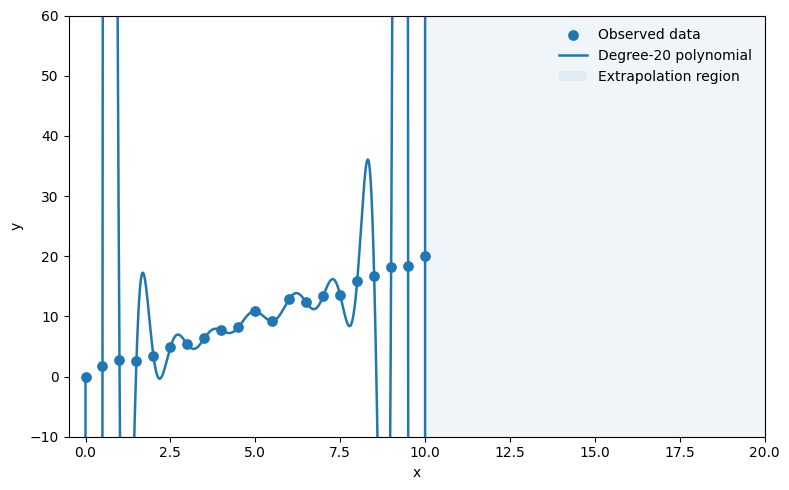
Can we say this is extrapolating now? What if I show you the entire dataset for our problem, rather than just the points in [0, 10]?
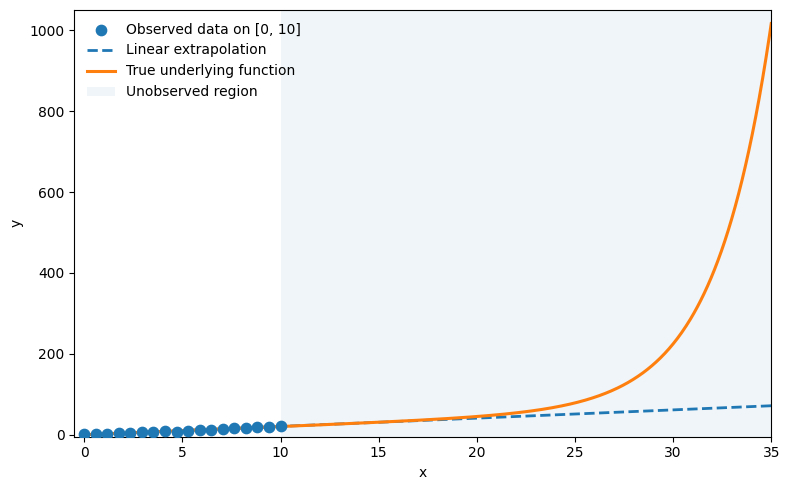
Now we see the full picture: our data was exponential all along! We only showed the part that appeared linear. So, that linear model we said could extrapolate indefinitely… it can, but beyond the observed range, its predictions go spectacularly wrong!
What the hell makes extrapolation useful, then?
Extrapolation necessarily depends on inductive bias
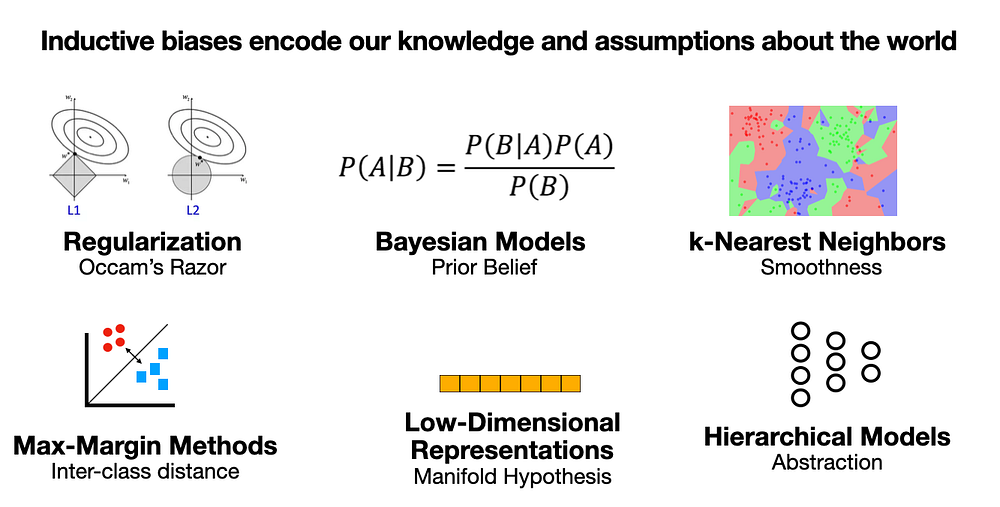
If the data does not tell the full story, infinitely many functions can agree perfectly with the observations but behave arbitrarily elsewhere. The data alone cannot tell you which continuation is correct. Extrapolation therefore necessarily depends on inductive bias. Architecture, regularization, optimization, pretraining, symmetry, equivalence, physical constraints, representation, and other factors determine which continuation the model prefers.
Who sets these inductive biases? We do, of course. We decide that data “looks linear”, so we fit a linear model. We decide that images lie on a low-dimensional manifold, so we use architectural bottlenecks and compression. The classical definition tells us where we’re predicting, but not whether our predictions deserve any trust. What we extend is the “idea” behind the data. What a mess…
Let’s turn the difficulty dial up to a frankly unreasonable setting. For the rest of this thought experiment, we’ll use a stricter definition than the textbook one: “Extrapolation is producing a meaningful response in a region outside the intrinsic support of the learned data manifold, rather than extending a rule already identifiable on that manifold.” In other words, we want to reach beyond what our learned representation already gives us grounds to infer. Now stuff starts to get interesting.
Under this absurdly strict definition, even deriving a new abstraction and using it to make a surprising prediction would not automatically count as extrapolation. If the abstraction follows from information already available, we’re still extending what we had. Let’s look at some human discoveries to see whether they fit our definition.
Can humans extrapolate?
The work of Newton and Einstein, the development of imaginary numbers and quantum mechanics, and other scientific revolutions feel like examples of humanity producing something genuinely new. But did these discoveries emerge from an informational void? Einstein didn’t randomly hallucinate general relativity. Existing observations, mathematics, previous theories, contradictions, and physical intuitions constrained the space of possible ideas. A discovery can therefore be extraordinarily novel while still being constructed from information already available to the discoverer.
When Newton inferred a gravitational law from observations and applied it to circumstances never observed before, the observations themselves did not logically prove that the same law must hold in those circumstances.
Science itself is therefore, in a sense, the search for representations and inductive biases that turn terrifying extrapolation problems into simple applications of invariant rules.
Invention works similarly. The Wright brothers didn’t retrieve “airplane” from an informational void. They discovered a configuration of previously available physical principles that produced something genuinely new. If you trace those ideas back, you eventually reach observations of nature and previously constructed abstractions.
I know these concepts seem obvious, and you’re probably thinking, “Duh, what does this even mean, and why are we talking about airplanes in an article about extrapolation?” Okay, bear with me a little longer, and I’ll make it worth your while.
Extrapolation depends on representation
Here’s the idea that’s been lurking under the furniture: extrapolation is relative to a representation. What looks like a leap into the unknown in one representation can become interpolation or a straightforward application of a rule in another. Change the concepts you use to describe the problem, and you change what counts as familiar territory.
Newton brought falling objects and planetary motion under the same gravitational framework. Einstein changed the framework itself, recasting gravity in terms of spacetime geometry. Neither move made every prediction automatically correct; experiments still had to do their job. But both show how a new representation can turn apparently separate problems into consequences of a common structure.
Representation learning and manifold discovery aim for something similar: finding variables in which useful structure becomes easier to express. A scientific revolution can change the map, rather than simply push a little farther along its edge. That doesn’t conjure information from nowhere. It makes previously hidden relationships available to thought. So “beyond the data” needs a follow-up: beyond the data in which representation? Otherwise, we may be arguing about the borders while someone quietly replaces the atlas.
The fun fact
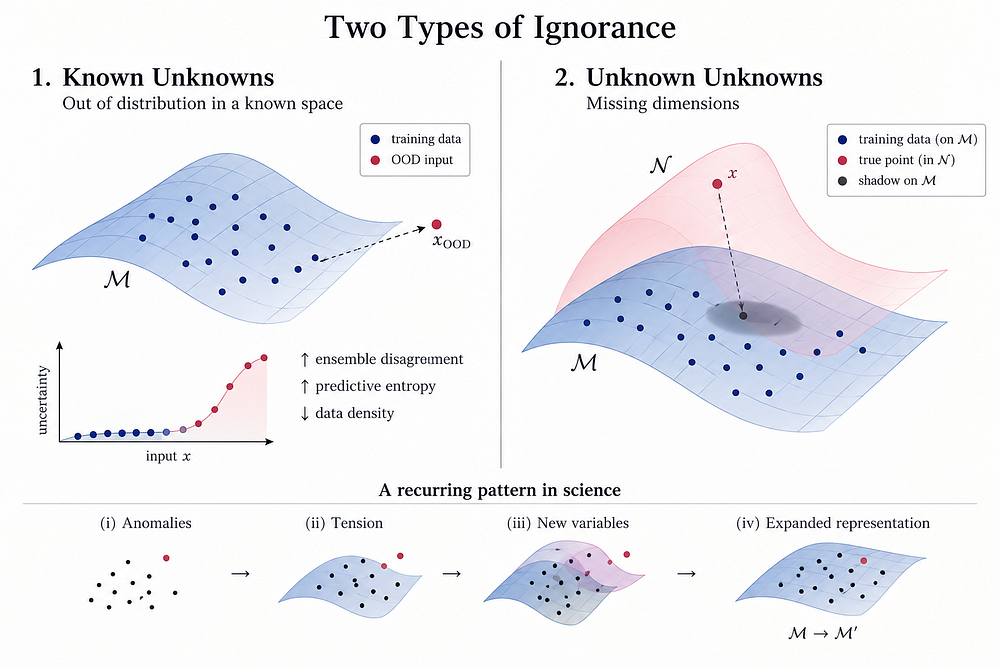
We can’t know what we don’t know. If everything you know fits within a learned manifold, you can identify some kinds of ignorance: “I’ve only seen temperatures between 0 and 100, and you’re asking about 500.” That’s detectable uncertainty. You know you’re leaving familiar territory. But there is a much nastier kind of ignorance: a relevant dimension of reality that your representation doesn’t contain at all. The first kind can potentially be quantified: models in an ensemble may disagree, predictive entropy may rise, or estimated data density may fall. These can be clues that an input is out of distribution (OOD). The second is fundamentally harder. An unknown dimension may cast a shadow onto your known manifold. Historically, science has repeatedly advanced through something resembling this process. Anomalous observations accumulate, the existing representation struggles to accommodate them, and eventually someone introduces new variables or a new conceptual framework. You often cannot directly see the void from inside your manifold, but sometimes you can see its shadow.
Information needs constraints
If informational structure cannot arise completely unconstrained, we’re pushed toward some irreducible informational substrate. Whether it’s finite, computable, axiomatizable, or even representable by minds like ours is a separate question. Reality never promised to fit on a cheat sheet. Let’s put on our ontological glasses and take a puff of the metaphysical vape.
First, let’s look at something we already have a formal framework for: mathematics. Mathematical systems have sets of axioms: foundational statements or rules accepted as true without proof. These serve as the starting points for logical deductions and mathematical theories. Gödel’s incompleteness theorem tells us that sufficiently expressive, consistent formal systems capable of arithmetic cannot prove every truth expressible within their domain. Here’s an interesting angle for our discussion: even knowing all the axioms of a mathematical system does not guarantee that we can derive every truth within it. We can work with that idea, but let’s not get confused here: Gödel’s incompleteness theorem does not tell us that the universe cannot be completely derived from fundamental laws. We are talking about an evolving physical system, so that conclusion does not follow directly. Thus, even if reality ultimately rests on a compact primitive structure, we should not casually assume that “all structure originates from these primitives” implies that “an embedded reasoner possessing those primitives can derive every truth”. Reality could have an extremely compact underlying structure while no finite reasoning system inside reality has complete epistemic access to all of its consequences.
Take a deep breath… okay, let’s keep going.
Second, let’s jump to physics. Laws constrain what can happen, but they need not specify everything that actually happens. Consider the four fundamental forces: gravity, electromagnetism, and the strong and weak nuclear forces. These forces govern how objects and particles interact. A surprisingly short cast of characters for such an elaborate cosmic drama. Still, a short cast list doesn’t tell you the entire plot.
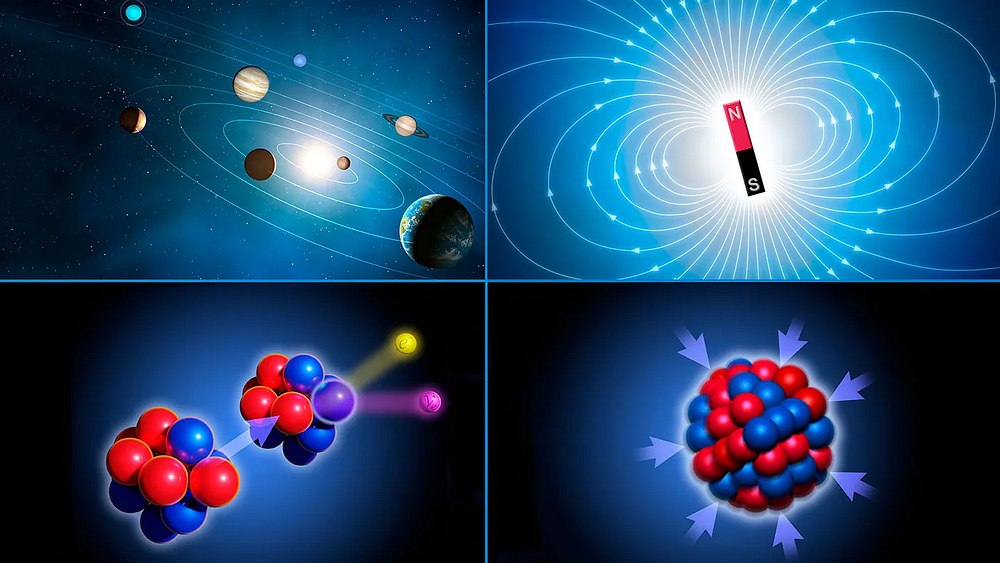
This brings us to another interesting fact: simple rules can generate astonishing complexity. New structure can emerge without new fundamental laws being introduced. So, does this new structure count as extrapolation under our strict definition? No! Sorry. The consequences may be new to us, but they still follow from the rules.
What do these primitive facts look like?
Let’s do a thought experiment. Think of a long string of characters that a short program can reproduce. Its algorithmic information content is small relative to its length. Kolmogorov complexity captures this idea through the length of the shortest program that produces a given finite string. But it doesn’t hand us a cosmic zip file, or a reliable way to know we’ve found the shortest program.
Perhaps we can compress more and more of reality’s regularities into simpler principles. That doesn’t mean the whole universe must eventually collapse into one tiny rule. We could have finite laws plus an endless supply of contingent information, algorithmically incompressible initial conditions, or a specification that is irreducibly infinite. An irreducible substrate might be where compression stops, without being something small enough to write on a napkin. The napkin was our idea.
Thomas Aquinas argued that contingent or dependent things cannot ultimately explain their own existence, so there must be something whose existence is not dependent in the same way. If everything is explained only by something else, you can ask whether the entire chain has an ultimate explanatory ground. Aquinas calls that ground God. Leibniz later asked, “Why is there something rather than nothing?” He also invoked the principle of sufficient reason: roughly, that there should be a reason why reality is one way rather than another. Our route follows a similar intuition: if information cannot arise unconstrained, perhaps reality’s informational structure ultimately rests on some primitive source. You can bring your favorite God into this if you want; I’ll take a more boring route.
If we remove the human viewpoint and even mathematics from the equation, we are left with the most abstract level imaginable. Perhaps only things like distinction, relation, possibility, constraint, and transition remain. For instance, the absolute minimum required for information is arguably distinguishability: there are distinguishable possibilities, and there is some structure specifying which configurations or transitions are possible. Everything familiar could then emerge from that.
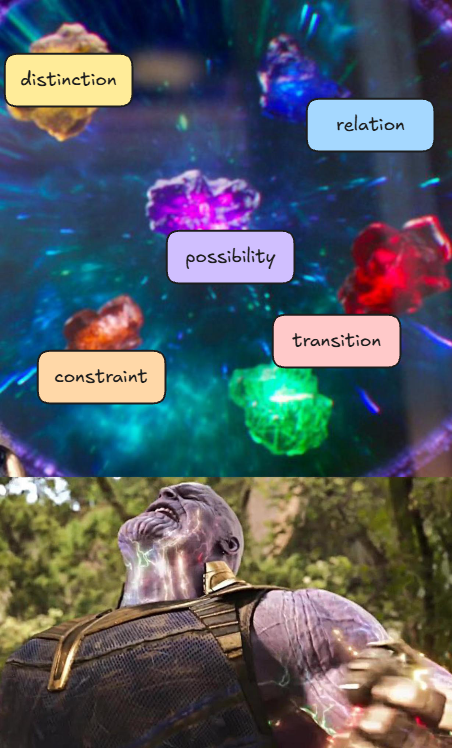
However, even this description is contaminated by our cognitive vocabulary… so we may simply be incapable of representing the primitive substrate except through projections onto concepts available to us.
Where would such a substrate come from? There is the boring explanation and the fun one. The boring explanation says that it exists because its absence is impossible. Attractive, but extremely anticlimactic. The fun explanation is that there simply is no deeper answer: reality is this way, and humans desperately need to ask “why”. But there is no logical guarantee that reality owes us an infinitely satisfying chain of explanations.
Knowledge CAN be created
Now we have to ask whether what we’ve cared about all along is knowledge rather than information. We want to discover things we didn’t previously know by drawing new conclusions from what we observe. But we have to be clear about what this process can and cannot do.
The idea that knowledge needs informational grounding does not imply that new knowledge cannot be created. A system can derive consequences that were not explicitly present in its observations, or discover a representation that makes those consequences accessible. What it cannot do is uniquely determine an unconstrained fact about reality from literally zero information about it.
If we consider the entire space of possible consequences of a set of foundations, any individual human has explored only a subset of it. We don’t possess the entire space of consequences. What we call discovery could be the expansion of that explored subset, as previously inaccessible consequences become representable. Nothing was created ex nihilo, but something genuinely new was computed, discovered, or made accessible.
If we wanted to create a hierarchy of concepts, it would look something like this:
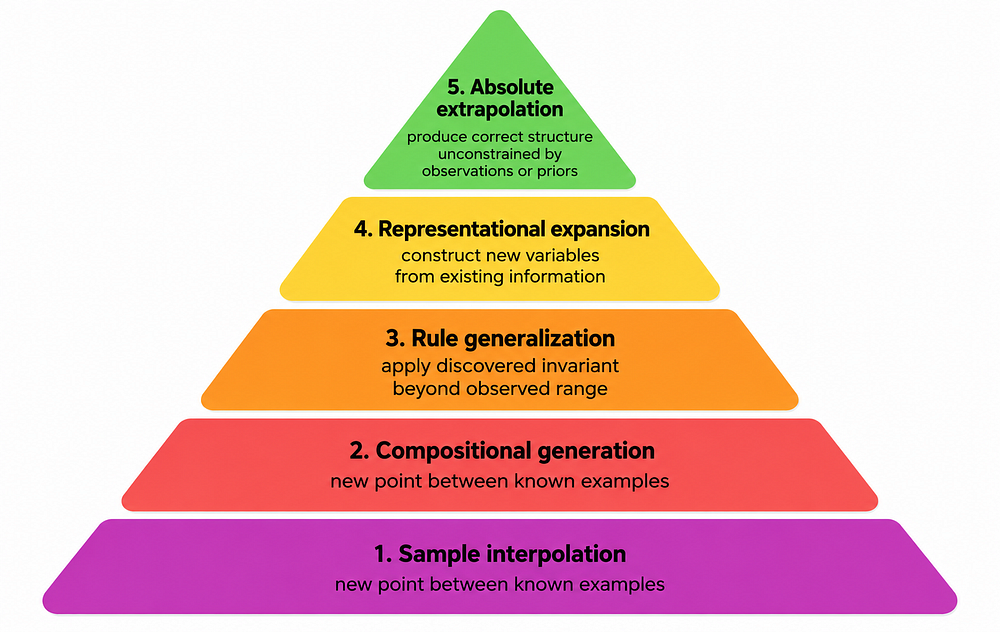
Humans clearly do levels 1 through 4. Current deep learning clearly does levels 1 and 2, and can do level 3 under appropriate conditions. Level 5 may simply be impossible for any information-processing system, human or machine.
Bro, pass the blunt
One last puff. Perhaps necessity and contingency give us a useful way to frame this: the structure constraining what can happen, and the particular history that actually happens. In information terms, we might picture compressible regularities alongside whatever those regularities leave undetermined. This is a way of thinking about reality, not proof that it comes neatly packaged in two boxes. Even finite laws could coexist with infinite contingent information. A short rulebook need not mean a short universe.
Here, we reach questions for which we have no settled answer… Why this underlying structure? Why this particular history among the possibilities it allows? Would a complete description even be finite, computable, or intelligible to us? We may never know. The universe has been terrible at answering support tickets.
So, to answer the initial question: under the textbook definition, yeah, AI can extrapolate. Under our strict, brainfuck definition, demanding knowledge with no informational grounding may set a bar that neither humans nor machines can clear. Between those extremes lies the interesting territory: new representations, new abstractions, and predictions that survive contact with reality.
The interesting question was never really whether AI can extrapolate. It was what kind of novelty is epistemically possible for any finite reasoner embedded inside the universe. What can such a system discover, represent, and justify from the information it can actually reach? How far can it redraw its own map, and which facts require going out and taking another measurement?
We don’t need to settle the universe’s ultimate architecture to ask those questions. We need to distinguish what is new to the reasoner, what follows from available information, and what remains genuinely unconstrained. The parrot gets a reprieve; our existential crisis does not.